No One Would Listen by Harry Markopolos

Many people confuse Accounting with Finance. Most people in the business world know the difference, but, in my experience, most people lump them together as “people who deal with money.” While they both do deal with money, that’s where the similarities tend to end.

Accountants track money and classify transactions. We figure out how the puzzle pieces all stick together. One of the reasons accountants aren’t very highly regarded in businesses is that we don’t often make money. We can save money in some instances, and we’re responsible for reporting information, but the decisions we are responsible for is oftentimes tangential to the actual business purpose.

Those in the finance world live by an entirely different set of rules. They speak the language of money as well, but in a different dialect: they make it. They make it in any way they can, repackaging it in stocks, bonds, options, derivatives, and all different kinds of forms that boggle the average person’s mind. They skim money off the top of every transaction, they come up with advanced mathematical models to maximize their return, and, in some cases, they just cheat people.

Supposedly, when these finance guys do cheat, the Securities Exchange Commission (SEC) is supposed to catch and prosecute them. They’re the main government watchdog set up to ensure that the massive amounts of money flowing through the financial markets is handled legally. Set up in the wake of the stock market crash in the Great Depression era, they were supposed to make sure investors were protected. Not necessarily from the normal market fluctuations — nobody can be protected from those — but from those bad guys that wouldn’t follow the rules.

No One Would Listen is about the failure of the SEC to actually do its job and, as a result, losing investors money to the tune of $40 billion. For those of you that may not recognize that number, it’s the result of over two decades of Bernie Madoff’s Ponzi scheme. It ended up taking money from hedge funds and individual investors around the world and, true to the Ponzi scheme modus operandi, never ended up actually investing it. Instead, it simply paid inflated returns year after year out of the money that it took in. The ability of Madoff to continue to yield these high returns relied on new cash coming in continually.

The author, Harry Markopolos, tried to warn the SEC that something was wrong with Madoff. He made something like five submissions to the SEC as he pursued Madoff and pointed out the discrepancies in his plans. Unfortunately, nobody listened, and the scheme persisted for two decades, growing all the while.

The book itself details Mr. Markopolos’s plight as he seeks to warn the SEC of impending doom. As a financial analyst himself, he was more than happy to show that steady returns month after month, even when the stock or options market tumbled, were impossible. Unfortunately, it wasn’t until the real estate market burst and Madoff ran out of money that Markopolos’ fears were validated.

The book, while accessible to many without a financial background, is very poorly written. The myriad of spelling and grammatical errors cry out for the hand of a good editor. The author comes across as eccentric, egotistical, and at many times petulant. Although this look at his inner psyche may be revealing, it doesn’t make for very involved reading.

I found myself skimming the last half of the book because it was simply the same information rehashed again and again. Markopolos was understandably upset with the SEC and does not hesitate to show it in his writing. Although he includes an appendix that details his plan to revamp the SEC — and reveals that he may have been on the short list to head the SEC at one point — his continued anger and resentment is palpable.

Overall, the book is a good insight into the seedier side of Wall Street. However, if you’re interested in the details of Bernie Madoff’s scheme, the Wikipedia article is probably a much better place to start.

Posted in Uncategorized | Leave a comment

Memory

One of the things that bugs me about being “only human” is the corresponding fuzziness of memory. I’ve known some people that have a knack for remembering specifics — I am not one of them.

In reality, I think I’ve trained my brain to be a rapid consumer of information, but not hold on to it for any length of time. I’m too used to absorbing a lot of information, but not giving it enough importance to stick around. Maybe I just don’t think about it enough; maybe there’s something else.

If there’s one thing that growing up being regarded as “smart” has taught me, it’s that a lot of supposedly smarter people just have better habits. Whether they just use mnemonics that were taught to them as a kid or just have a talent for breaking down patterns into easily remembered stubs, it doesn’t seem like that’s impossible to duplicate.

So, in an effort to remember some of the useful stuff that occurs to me and ends up leaking out the other side, I’ve started a journal. It will be my ever-present companion, should I indeed stick with this habit. If not, it’ll still be a learning experience. I fully expect to go through a time where I’m getting used to it and developing shorthand, figuring out ways to trigger memories, etc. I’ve been using it today and have had a lot of fun – forcing myself to stop and write things down makes me really think about stuff.

The plan so far is to write interesting/important/thoughtful things down. I will review them at the end of the day, review the previous three days in a “rolling window” to make sure the past few days have stuck, and then do a weekly blog post or something. I’m thinking every Sunday. Nothing huge, just something to get it all back in my brain.

I also plan on incorporating things like memorable phrases in this: if I write down one memorable phrase and repeat it a few times throughout the day, then the next few days, then the week, I have a feeling it’ll stick. My goal is one per day, so we’ll see how that goes.

My passion for this has been a long time coming, but it really came to a head the other day when I was at the gym. I kept on thinking about all the stuff I wanted to do and improve: sky diving, scuba diving, mental math, foreign languages. A lot of the activities I wanted to do involved heavy mental lifting. The underlying muscle for that is really my memory. I wouldn’t go mountain biking, run a 10K, or play tennis if I wasn’t physically fit. Why, then, not work on being mentally fit? This is, hopefully, the successful start of a long journey.

Posted in personal | Leave a comment

Paradox of choice, again

I recently retrieved Free from its dusty spot on my toilet (it’s my favorite spot for books that I want to read but haven’t quite gotten to yet). As I was reading through it, a portion about how something being “free” affects our psychology really affected me. It stated that eliminating a price eliminates people’s intrinsically human fear of making the wrong decision. If something is even 1 cent, according to Dan Ariely, it triggers a fear of what the consequences may be.

It’s an interesting thought, isn’t it? It’s something that I can certainly stand behind, as I tend to think about the consequences of spending my money pretty heavily.

It’s funny to me how this represents a weird kind of dichotomy. My gut reaction upon reading this was to think “man, if this is triggering some kind of fear in me, I should figure out how to eliminate as many decisions as possible.”

That’s really only one piece of the puzzle, though.

Let’s swing to the opposite end of the spectrum: what happens if we don’t have any choice? We start resenting it and we start not caring. Think about all those community college dropouts that don’t care about their education.

So it seems like there are different categories of choices. There are those that really don’t matter, yet still exact a toll on us. They take up time, worrying etc. Then there’s another category, those that matter: these are the things we should worry about. We have to make those choices — otherwise, they may not matter enough or they may not really represent where we want our lives to go.

I think that, in my life at least, I’m way too worried about that first category – the category that doesn’t matter. Or, I should say, I put too many things that should be in the first category into the second “necessary” category. The chances of me not being happy with something are actually pretty damn low. I’m happy with most everything. So why in the world am I worrying so much about it?

I really need to stop worrying so much.

Posted in Uncategorized | Leave a comment

Leadership board

One of my goals this semester was to get as involved as humanly possible. I think I can safely say that I’ve achieved that goal. A few days ago, I squared away all my Beta Alpha Psi points, with plenty to spare. I wrapped up being Director of Wednesday Technical Meetings for the Accounting Association and have heard rumblings that I’ll be Director of Student Development for the upcoming Spring semester. The Saturday Seminar led by Diana is officially on hold as far as class sessions go, but it’s constantly on my mind.

Last of all, there’s the Ernst and Young Leadership Seminar. For those that don’t know what the seminar is, it’s a weekly session facilitated by Ernst and Young professionals (for the most part). The topics range from how to have useful conversations (“fierce conversations”), trying to figure out what drives you, to diversity and much more. There’s only so much that can be accomplished within a two hour weekly window and the topics tend to move pretty quickly, so it’s difficult to point out any one particular thread or topic that the seminar covers.

While there’s no homework involved in the class, there are two assignments. One is a community college outreach program – for me, it involved heading back to Moorpark College and presenting on the ACCT/IS program at CSUN (as a side note, I attended one of these presentations myself three years ago, it’s one of the things that solidified my Accountancy major choice). The other assignment is developing a “leadership board” – a board that defines what we learned about ourselves and how we see ourselves developing as a leader. Sounds right up my alley, right?

The only problem is, it’s really not that easy for me. I mean, my view on leadership is such a hodgepodge collection of different ideas that it’s hard to distill down to an essence. I view myself as a newborn when it comes to leadership. I’m trying to get as much exposure to it as I can, but I haven’t had much chance to practice it. It’s rather like accounting or IS: I have a theoretical background, but I have little practical experience.

I remember my first job out of high school as a customer service coordinator at HomeGoods. I looked up to my manager, Gary, because he seemed like a good leader. Now, I look back at his petty nature and underhanded dealings and wonder how the store managed to do well. It’s interesting to think about how my views on leadership have changed. It used to be that, like Gary, the people I looked up to were the ones that had power granted to them by their title. Whether it was manager, professor, or CEO, the title did it for me. That was all I needed.

Then, I figured out that a title doesn’t mean all that much. There are good leaders that have no official title. There are terrible leaders that have the highest titles. In fact, I would almost say that there are more leaders of the latter kind than former. The more I learn about leadership, though, the more I realize that it doesn’t matter to me. It reminds me a lot of one of the sayings my dad went through the trouble of printing out and handing to me: “Leadership is in your actions, not your title.”

So, with these conflicting ideas of leadership rattling around in my head, the question still stands: where do I see myself going?

I think the answer for me, right here, right now, is this: I see myself being more like me.

That sounds weird, right? At least it looks weird to me when I read it. However, I think it’s true. I don’t think the me that I am right now is really me. There’s too much of other people, of my past experiences, of my unknown biases for it to really be me.

As a good friend and mentor once explained it, it’s like a pencil: take all your biases and thoughts about a pencil away, remove the past and future of the pencil, and it’s still a pencil. I don’t think I’m to that point with myself yet. I still think of myself as a product of my actions, of my experiences, of even my biological background. I know appallingly little about me.

So, I see myself becoming more like me. And, as I get to be more like me, I think my own style of leadership will develop. If I had to predict, I think it’ll incorporate a lot of elements of other successful leaders, but it won’t be because I’m really trying to emulate or be them. It’ll be because I’m me.

Posted in leadership | 1 Comment

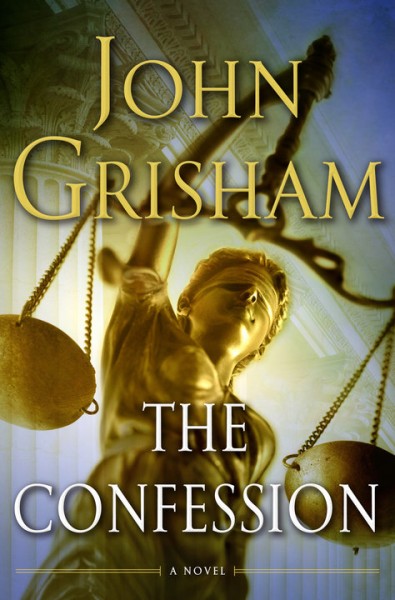
The Confession by John Grisham

The following book review appeared in the Tuesday, November 30, 2010 edition of The Daily Sundial:

What would you do if a lanky ex-con walked into your office, plopped down on a chair, and proceeded to tell you that he had raped and murdered a high school cheerleader – and that, worst of all, someone else was going to die for his sins? In “The Confession,” John Grisham’s latest legal thriller, a humble small town minister is vaulted into a battle against time as he seeks to clear the name of Donte Drumm, a high school football player sentenced to death for a crime he didn’t commit.

While Grisham focuses on a few main characters, including Keith Richards, the minister, and Travis Boyette, the repenting ex-con, other characters are introduced at timely intervals throughout the story. There’s Donte Drumm, the aforementioned black high school football player who confesses to murder under the extreme interrogation techniques of the white, corrupt local police. Despite a complete lack of physical evidence and a proven romantic link between the prosecutor and the presiding judge, Donte is sentenced to death.

After wasting away physically and mentally for years on Death Row, his time is up: the execution is scheduled mere days away and the last minute appeals have all been denied. Unbeknownst to him, his only hope is Boyette’s confession and, even then, the confession may not be enough to stop the execution. There’s also Donte’s dedicated legal team, including his fiery defense attorney Robbie Flak. After trying for almost a decade to exonerate Donte, Flak proves to be so jaded that he refuses to hear Boyette’s confession. The clock continues to tick as the minister and his ex-con cargo race across state lines to save Donte.

These characters serve as Grisham’s soapbox on which to preach. While there are a variety of characters, many of them serve as merely faces for stereotypes: the minister conflicted about the “right thing to do”; the ex-con with a cane, a twitch, and a history of sexual abuse; the mother of the murdered cheerleader who soaks up all media attention; the corrupt racist lawyers and police that lock up an innocent boy; and even the bloodthirsty Governor of Texas that is willing to kill someone for an uptick in approval ratings. These one-dimensional aspects, however, are often unimportant as Grisham continues to weave an engrossing tale. The book’s four hundred pages start flying by as all you want to see is Drumm go free, the bad people pay for their sins, and the world to prove itself as an orderly and just place.

Having debuted as the number one best seller on the New York Times Best Seller’s list and sticking in the top three for the past three weeks, there is no doubt that Grisham continues his blockbuster record with “The Confession.” It is easy to see why his books, such as “The Firm,” are so easily adapted to the big screen: Grisham’s masterful writing keeps you on the edge of the seat from start to finish. Even the ending of “The Confession,” which stretches slightly longer than is typical, is gripping. For those readers that hate not knowing what happened to each and every character – “good” or “bad” – this book will definitely leave you with a good taste in your mouth. The last fifty pages are dedicated solely to giving a rundown of what happened to each character.

Ultimately, “The Confession” presents little new in the way of a unique storyline. However, the story is told extremely well and is quite enjoyable. Grisham does a fantastic job of shedding light on the legal machinations behind the death penalty, including some of their gaping flaws. As “Aesop’s Fables” has shown us for millennia, sometimes it takes a good story to really drive a point home.

Posted in Uncategorized | Leave a comment

The Giver by Lois Lowry

Every now and then it’s nice to pick up a book without absolutely any idea of what it contains. As a side effect of my frequent “Add to Wish List” sprees on Amazon, this tends to happen to me pretty often. I’ll add something that sounds interesting, promptly forget about it, and end up ordering it randomly or receiving it as a gift. I love it.

So, The Giver showed up on my desk and I had no idea what it was. It looked short – 200 or so pages – and the cover didn’t offer up any clues. It has a black and white picture of an old guy with a beard. Very provocative, indeed. He actually reminded me of the professor from Count of Monte Cristo and made me want to go watch the movie again. Yes, yes, I know, this is about book reviews, but I actually like the movie. Come on, it has Richard Harris! Fine, fine, back to the book review.

The Giver is set in a somewhat sci-fi world that is similar to our own, if maybe a little more technologically advanced. The community that the book takes place in is a neat, orderly society where nothing is left to chance. Feelings have been eradicated through years of careful manipulation. The population is tightly controlled and children are “assigned” to families regardless of their ancestry. Citizens are placed in their roles without any personal say, although the assigners watch each individual to try to make them as happy as possible.

The only strange technology that makes The Giver feel more sci-fi is the namesake: the Giver. This individual, selected for the task by his predecessor instead of being “assigned,” is responsible for being the bearer of memories. You see, in The Giver, memories aren’t stuck in your head. The Giver can transfer memories. And, if the Giver exits the area surrounding his community, the memories that he possesses are set “free,” and the community reabsorbs them.

The main story revolves around Jonas, the newest Giver. He must go through training and learn about life by living through memories. He must take on the burden of the current Giver’s memories, so he cannot be shielded from all of the knowledge that entails. Memories of snow, sunshine, color, lust, pain, and sorrow — things that do not exist as far as his community is concerned — become his burden.

The book itself goes by pretty quick, but I did find it a little slowly paced. I don’t know if it’s because supposedly for kids or not, but I think it could have been cut down to about half the size with the same impact. Not much really happens – instead, the author tends to spend a good chunk of time explaining the society that she has manufactured. Much of it is unimportant beyond stressing exactly how orderly and “safe” it is. An inordinate amount of time seems to be spent describing bicycles. What an honor it is to ride them. How they have bike stalls everywhere, where bikes should be neatly parked. The ritual “illegal” training of underage kids to ride bikes. And so on.

Memories are something I find really interesting and the idea that you can transmit them (more directly than by storytelling) seems like a neat idea. However, I’m not really sure what the point of the book is, if there is a point. The most obvious corollary would be Orwell’s 1984 for a more juvenile audience. The Giver doesn’t do a very good job of communicating the fear and oppression that comes across so readily in 1984, so the impact isn’t really felt.

In the end, maybe it’s seen as literature for young adults for a reason. I think that if I had read this prior to 1984 and some other eye-opening works, the message would have been better received. Once my brother starts popping out kids, I’ll have to pass this one on to his children.

Posted in book review | Leave a comment

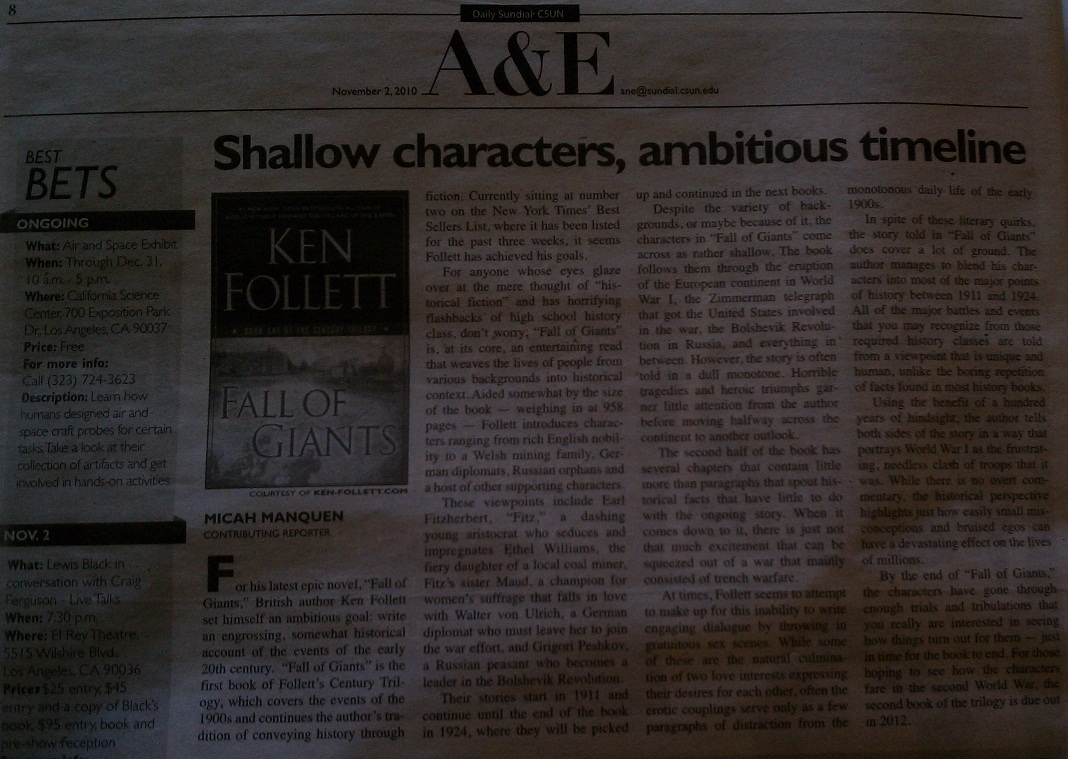
Daily Sundial Book Review: Fall of Giants by Ken Follett

The following book review appeared in the Daily Sundial on November 2, 2010. I volunteered to do book reviews for the newspaper (on campus) gratis because, well, it’s obvious that I don’t have enough to do. There will be another one appearing next Tuesday, December 30, on John Grisham’s The Confession, which I’ll be sure to cross-post here. The tone of these articles is markedly different from those appearing only on my blog, as they are for a wider audience.

Shallow Characters, Ambitious Timeline

For his latest epic novel, “Fall of Giants,” British author Ken Follett set himself an ambitious goal: write an engrossing, somewhat historical account of the events of the early 20th century.  “Fall of Giants” is the first book of Follett’s Century Trilogy which covers the events of the 1900s and continues the author’s tradition of conveying history through fiction. Currently sitting at number two on the New York Times Best Sellers List, where it has been in attendance for the past three weeks, it seems as though Follett has achieved his goals.

For anyone whose eyes glaze over at the mere thought of “historical fiction” and has horrifying flashbacks of high school history class, don’t worry. “Fall of Giants” is, at its core, an entertaining read that weaves the lives of people from various backgrounds into historical context. Aided somewhat by the size of the book – weighing in at 958 pages – Follett introduces characters ranging from rich English nobility to a Welsh mining family, German diplomats, Russian orphans, and a host of other supporting characters. These viewpoints include Earl Fitzherbert, “Fitz,” a dashing young aristocrat that seduces and impregnates Ethel Williams, the fiery daughter of a local coal miner; Fitz’s sister Maud, a champion for women’s suffrage that falls in love with Walter von Ulrich, a German diplomat that must leave her to join the war effort; and Grigori Peshkov, a Russian peasant who becomes a leader in the Bolshevik Revolution. Their stories start in 1911 and continue until the end of the book in 1924, where they will be picked up and continued in the next books.

Despite the variety of backgrounds – or maybe because of it – the characters in “Fall of Giants” come across as rather shallow. The book follows them through the eruption of the European continent in World War I, the Zimmerman telegraph that got the United States involved in the war, the Bolshevik Revolution in Russia, and everything in between. However, the story is often told in a dull monotone. Horrible tragedies and heroic triumphs garner little attention from the author before moving halfway across the continent to another outlook. The second half of the book has several chapters that contain little more than paragraphs that start “The next day…” and spout historical facts that have little to do with the ongoing story. When it comes down to it, there is just not that much excitement that can be squeezed out of a war that mainly consisted of trench warfare.

At times, Follett seems to attempt to make up for this inability to write engaging dialogue by throwing in gratuitous sex scenes. While some of these are the natural culmination of two love interests expressing their desires for each other, often the erotic couplings serve only as a few paragraphs of distraction from the monotonous daily life of the early 1900s.

In spite of these literary quirks, the story told in “Fall of Giants” does cover a lot of ground. The author manages to blend his characters into most of the major points of history between 1911 and 1924. All of the major battles and events that you may recognize from those required history classes are told from a viewpoint that is unique and human, unlike the boring repetition of facts found in most history books. Using the benefit of a hundred years of hindsight, the author tells both sides of the story in a way that portrays World War I as the frustrating, needless clash of troops that it was. While there is no overt commentary, the historical perspective highlights just how easily small misconceptions and bruised egos can have a devastating effect on the lives of millions of people.

By the end of “Fall of Giants,” the characters have gone through enough trials and tribulations that you really are interested in seeing how things turn out for them – just in time for the book to end. For those hoping to see how the characters fare in the second World War, the second book of the trilogy is due out in 2012.

Posted in Uncategorized | Leave a comment

Recruiting

I remember sitting through “Recruiting Boot Camp” a mere 3 months ago. Up in front of the classroom were some of my peers telling about their experiences going through recruiting for internships. “Be careful,” they said, “going through recruiting is like a full time job.”

Oh how I should have heeded those words. I thought I would be okay since I cut back my hours at work to three days a week. I was only taking four classes, after all, right? However, after resume workshops, mock interviews, application deadlines, on-campus interviews, pre in-house dinners, in-house interviews, after-interview lunches and dinners — I can safely say that I didn’t have any idea what I was getting into. Thankfully my work has been blessedly flexible, allowing me to work an average of two days a week – and often skipping out early on those meager days.

For all that, I wouldn’t change it for the world. The recruiting process is your chance to stand up and show yourself off. It’s a great learning experience that teaches you as much about yourself as it does about the firm. It lets you answer those nagging questions like “how would I act in in a room full of people I don’t know,” “what am I going to say when they ask all these behavioral questions,” and, eventually, “what do I value in a firm that I want to work for?”

I was surprised in a couple of my interviews when the interviewer confessed that they didn’t believe that the standard interview told you must about a person. After going through them, I agree. It’s a lot like dating:

  1. You chat someone up amiably (Meet the Firms) and you get their number (business card)
  2. You fret anxiously as to how long to wait to call and what to say (application/cover letter)
  3. You call them and (invariably) get voice mail (that interminable wait until you get the on-campus invitation)
  4. You put on your Sunday best and double and triple think every possible thing that could happen and go on the first date (on-campus interview)
  5. Round 2 (of many) of fretting anxiously to see if you can get another date (after on-campus interview).
  6. You get a second date (in-house) and are told that this will be longer and harder like the first. You’re meeting her friends and family, so you have to be on your best behavior.
  7. You survive the test and are rewarded with a kiss for your success (post in-house lunch).
  8. She calls you to see if you want to do something (offer letter). At the same time, hopefully, you’re getting calls from her three other drop-dead gorgeous siblings that want to take you out too.
  9. ???
  10. Accept offer.

Step 9 is where it gets murky. At this point, you’ve been wined and dined (although you’ve probably got more coming), and the ball is in your court. In my example, there are four ladies after your heart and each of them are similar (being of the same heritage) but different (being of different character). How do you choose?

No matter how you chop it, it’s a pretty good situation to be in. Having multiple offers makes it tough to choose, but it’s always better to have the choice than to not have the choice. It gives you power; not necessarily the power to negotiate a higher salary or anything like that, but power to choose what’s right for you, not what’s right for them.

My decision was agonizingly difficult, then surprisingly easy. The thing that mattered to me in the end was where I think I would be a good fit. For me, that was KPMG. It was an easy choice. However, if you ever find yourself in my position, here are some things that helped me (and may help you too):

  • Take any notion of “pro” and “con” and throw them out the window. I can’t count how many people told me to do this and I refused. It’s worthless – I’ve never seen or heard of anyone that was able to write out pros/cons and make their decision based on it. Anyone that does ends up regretting it and second-guessing their choice. You’re weighing arbitrary attributes with arbitrary values and end up with an arbitrary rating that will just further confuse you.
  • Reaching out to people is all well and good, but the decision is up to you in the end. A ton of people will ask you what’s going on in your head. You’ll want to ask a ton of people what they think you should do. Trust me, it won’t help. You know what helped me? Finding someone that knew nothing about Accounting or the Big Four and explaining the whole situation to them. For me, that was my dad. I went through and told him about the whole process, the industry, and described the firms that I had gotten offers from. By the end of the discussion – even before any back-and-forth about what each firm offered, he said “Well, it sounds like you’ve made your decision. Let me know if you change your mind.” I hadn’t told him which one I wanted — or even that I hadn’t chosen one, yet he knew just from my descriptions which one I really wanted.
  • Realize that any choice that you make, it will still be up to you to make it a place you want to be. The firm does not cater to you. Trying to change the firm to your tastes will be like Sysiphus all over again. Try to choose the firm that will make the best fit for you, but realize you’re still going to have to work to make it a place you enjoy working.
  • Once you realize that a logical decision (pros/cons) isn’t going to make you happy, and that you’re still going to have to make yourself fit the firm, the choice really boils down to what will make you happy. This is different for everyone, but for me it was the people. I walked away with every interaction with KPMG people with a smile on my face and an aura of excitement that I didn’t feel anywhere else. I’d like to say that it took a lot of introspection and reflection to figure that out, but it didn’t. KPMG — and the thought of working for KPMG — put a smile on my face. Easy peezy.
Posted in Uncategorized | Leave a comment

Saturday Seminar, 1 of ?

I remember remarking to a friend a few months ago that there doesn’t seem to be any time to sit down and talk anymore. Remember those days back in high school where you could call anyone, anytime, and have a heart to heart discussion on anything? Of course, in those high school days, the topic of conversation was more likely to be about the latest movie than the philosophies of life, but it still happened on occasion.

The Saturday seminar on leadership that I’ve been attending seems like it solves that problem: from 12 to 2 on Saturdays, I can guarantee that I will be surrounded with 15 or so other motivated, diverse people that will talk about interesting stuff. It’s like being part of a hand-picked think thank except the issue that we’re thinking about is, quite often, leadership. It’s “facilitated” by our “guru” (my own choice of title, not hers), but the conversation is quite organic and fulfilling.

Our first topic a few weeks ago revolved around finding a definition of a leader. It got to be an intense discussion about the qualities that leaders possess, qualities that they don’t possess, and all kinds of other things. Hitler came up, of course — what would a good conversation about leadership be without him? At the end of the session, our guru left us with this piece of knowledge:

Leadership Rule #1: Leaders always have the initiative.

The words “have” and “initiative” are the two key words and chosen very precisely, I came to understand; however, I think their importance is easily discerned with a little thought.

I tend to enjoy playing devil’s advocate in a lot of situations. It’s not that I necessarily like to shoot people’s ideas down. I do it often in my own analysis of situations and problems that I have to solve. In my analytical mind, I can’t be sure of a solution until I’ve attacked it from all sides and am relatively sure it’ll stand.

This was easy to do for most of the discussion about leadership qualities. Someone asserts that a definitive characteristic of a leader is that they act morally, even in the face of negative consequences. OK, well… I can think of plenty of leaders that don’t act morally. Someone else asserts that a leader must make choices that benefit the most people (hi, utilitarianism!). That certainly doesn’t fit my definition of a leader and, judging based on the various competing ethical philosophies, I’m not the only one.

But “leaders always have the initiative”… that’s a hard rule to argue against.

The one thing that really strikes me about this view of a leader is that it’s not something that can be taken by force. It’s something that has to be given. Maybe not always entirely willingly, but it does have to be given.

Initiative implies that there is more than just the leader sitting in a vacuum. If there is just one person, initiative is meaningless – you don’t have initiative over anything or anybody else. The only thing you could possibly have initiative over is yourself, in which case you’re really fighting conflicting ideas within yourself; whether you do something or not is completely up to you. (insert entire series of blog posts on the difference between “you” and “your mind,” to be tackled at some other point)

So, if there’s more than one person, the other people have to be willing to give up their initiative and follow you. Otherwise you won’t have initiative and won’t be a leader.

In ye olden days, it was probably a lot simpler and very well defined: monarchs had the ultimate in initiative, aristocrats less so, etc etc, down to the peasants who very rarely held initiative within their society. Nowadays, in the myriad groups and roles that we play, it seems a lot murkier to figure out who has initiative. And it’s something that is given to you by default less and less.

Now, you have to earn it.

It seems like capitalism runs rampant in our world even when the capital is initiative.

I hope the earning of initiative is something that we discuss in our Saturday seminar, as it has a whole bunch of interesting questions wrapped up into it. It rather reminds me of The Prince. They say Hitler kept it on his nightstand. Since it has a lot to do with gaining — and keeping – initiative, I can see why.

Posted in Uncategorized | Leave a comment

Barry Schwartz – The Paradox of Choice

I recently found myself over at the TED site watching some random videos. It’s a great site that will surreptitiously eat up hours of your time. It’s also interesting to see the various presentation styles and, at ten to twenty minute intervals, allow you to digest a large amount of information in a short amount of time.

The presentation that really started the wheels turning tonight was by Barry Schwartz. It has to do with “The Paradox of Choice.” According to Mr. Schwartz, one of western society’s underlying values is that more choices means more happiness. And, in his eyes, this assumption is false. Sure, it may hold true to some extent. But then you devolve quickly into the realm of too many choices and find that you don’t want to make a decision, feel bad about making a decision, etc etc. Happiness does not increase linearly with the amount of choices that you are presented with.

Of course, one of the first things that popped into my head was my choice to going into Accounting. Does the paradox of choice hold true here? I think it does.

Think about it: as a student, you have a ton of choices. You can major in just about anything (notwithstanding family pressures, availability of major at your school, etc). The idea is that you choose something and you stick with it for the rest of your life. If I had continued my Computer Science major, I would have been stuck with it. Forever. That’s a long time for someone who is usually made to decide at some point in high school or shortly thereafter.

Looking back to my life in general before I made the conscious decision to do Accounting and Information Systems, I was less happy in general. A large part of my time was sucked up just pondering the future. Yes, the possibilities were limitless. But that actually damaged my overall happiness. As soon as I made a choice that eliminated a lot of options, I was almost instantly happier.

It’s not just me, either. I’ve seen it in others that have gone through the same decision making process. The results are pretty dramatic.

I mean, just think about the last time that you and a friend tried to figure out somewhere to go to eat. You figure out that you’re both hungry. You figure out that you want to go out. Maybe you even have a certain type of food that you want. Even then, you spend a lot of time and effort to make sure that you’re making the right decision. On something as trivial as a meal. Morgan and I are often prime examples of this – it takes us way longer than it should to figure out where to eat. And, in the end, we’re often not all that happy with our choice anyways. The best meals consist of: “You know what I’m really craving? Sushi.” “Me too!” “OK, let’s go.”

It’s almost like one of my favorite quotes: “it’s not what you know, but who you know.” Except in this instance it’s “it doesn’t matter what you decide, it matters that you decide.”

Now that we’ve figured out that more choices doesn’t equal more happiness, how do we change our behavior?

Well, I would say that there are unlimited choices for changing behaviors.

But I guess that wouldn’t quite make us happy, now, would it?

Posted in information, ted | 1 Comment